
THE USEFUL PART
- Microduck's robot software and its training environments are public under Apache-2.0 now; the 3D meshes are public only under a non-commercial licence, and Pollen says the hardware is not open source.
- Pollen's roadmap, dated 26 August, lists the app and the SDK as missing; its press kit says the SDK comes before the first robots ship.
- Pollen still targets first deliveries before Christmas 2026, but we could not confirm a date for a new order; two outlets report four to six months, then after April 2027.
Stars before shipping
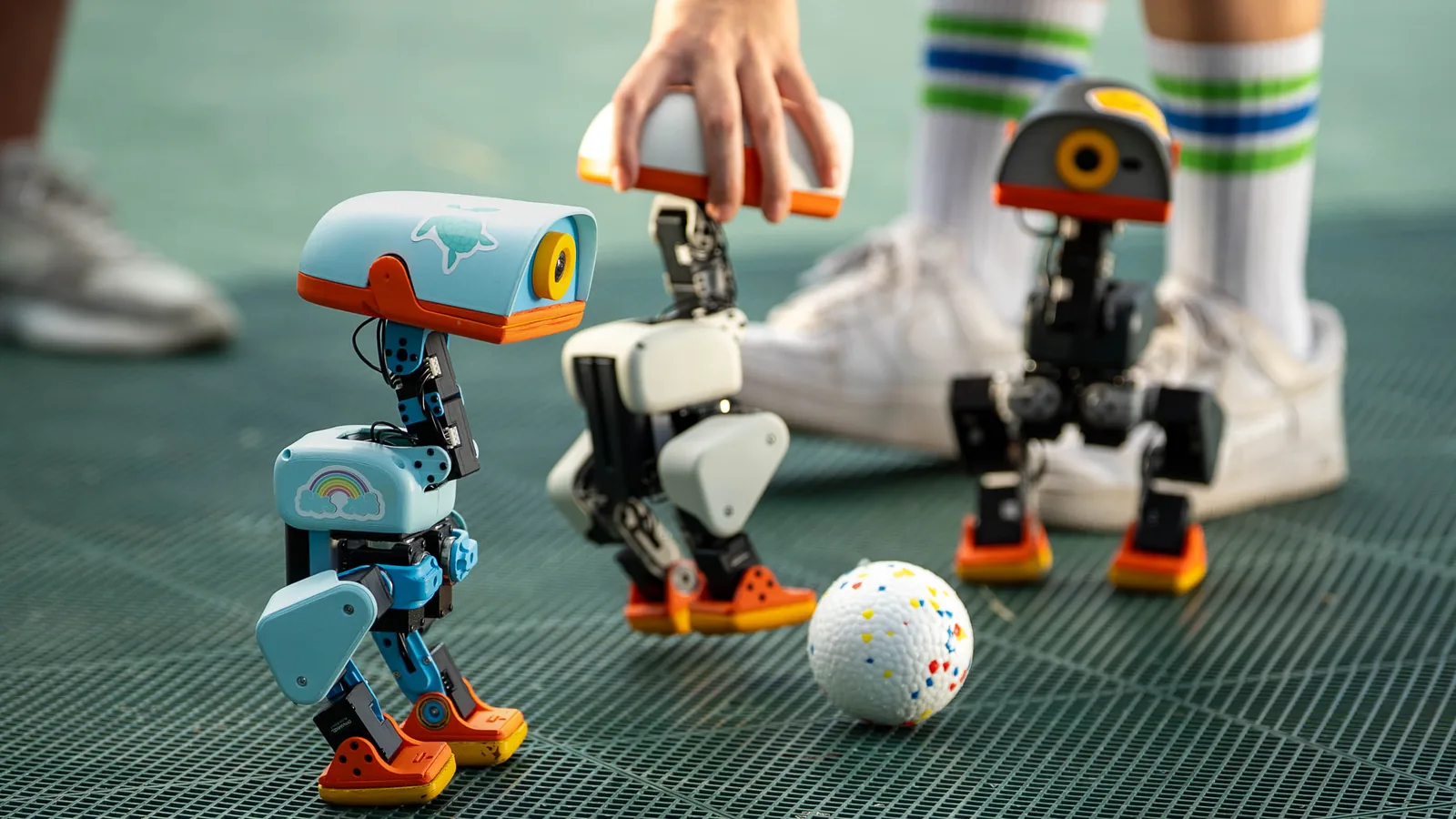
Microduck, the 25 cm walking robot from Pollen Robotics, the Bordeaux-based robotics team at Hugging Face, is still a $399 pre-order [6][7]. Its code is already busy. On 29 October 2026 at 18:19 UTC the main repository, pollen-robotics/microduck, had 13,059 GitHub stars and 1,616 forks, three months after it was created on 29 July [1]. The software for Reachy Mini, Pollen's other consumer robot, has 1,616 stars after 17 months [3].
On 21 October four Microducks joined NVIDIA's Jensen Huang on stage at his GTC Berlin keynote, "sitting down, standing up and even taking a nap on cue," NVIDIA's live blog of the keynote reported [8]. TechCrunch reported that pre-orders passed 20,000 units by the next day, citing a post on X by Hugging Face's Clem Delangue [9]; we cannot read X, so we could not check it. Pollen's chief executive, Matthieu Lapeyre, said about 15,000 more orders came in within three days, Seoul Economic Daily reported [10].
What is public
Two repositories of Apache-2.0 code. microduck holds the software the robot runs; microduck_rl holds the reinforcement-learning training environments and has 2,734 stars [1][2]. Pollen published releases 0.18.0 and 0.18.1 of the robot software on 29 October [4].
A frank roadmap [5]. Dated 26 August and last changed on 23 September, it lists what was built: an over-the-air updater, a 50 Hz loop that drives walking, standing and rolling through a safety layer, gamepad control, camera streaming to a browser on the local network, and 942 passing tests. It also lists what was missing: "the app, the SDK, the policy channel, the autonomous brain, and reaching a robot from outside the LAN." Later code may have closed some of these; the file still lists them.
What is not
Open hardware. Pollen's press kit is explicit: "The open-source statement covers the software stack. The mechanical and electronic design files are not, so please do not describe the robot as open-source hardware" [6]. Pollen's own product page still calls Microduck "a 25 cm open-source biped" [7], and TechCrunch called Microducks "open source devices" [9]. Read "open source" here as the software: the 3D meshes of the robot's parts are public in the training repository, but under CC BY-NC-SA 4.0, a non-commercial licence, not Apache-2.0 [2].
Final specifications. Camera resolution and field of view, LiDAR range, radio versions, SDK languages and any age recommendation are "still being finalised," the press kit says [6].
A delivery date for a new order. The press kit still lists first deliveries as "Targeted before Christmas 2026" [6]. Pollen's store refused our reader on 29 October. Two outlets that read the store this month report something later: The Gadgeteer (24 October) saw "four to six months for new orders" [11], and Stark Insider (28 October) quotes a banner saying current pre-orders should "ship after April 2027. First ordered, first shipped" [12].
The orders reach suppliers too. Robotis, the Korean maker of Dynamixel actuators, will supply about 750,000 actuators, 15 per robot, against current demand Pollen put at 50,000 units, Seoul Economic Daily reported on 27 October [10].
Key details
Pollen's figures, read on 29 October 2026 from its press kit and Microduck page [6][7]; several are still provisional.
| Item | What the sources say |
|---|---|
| Price | $399 introductory pre-order price, before taxes and shipping |
| Status | Pre-order; North America and Europe at launch; first deliveries targeted before Christmas 2026 |
| Delivery for a new order | Unknown from Pollen; Stark Insider read "after April 2027" on the store on 28 October |
| Size and weight | 25 cm tall, 14 cm wide, under 800 g |
| Motors | 15 |
| Computer | Rockchip RK3566 with AI accelerator; 1 GB RAM, 32 GB storage |
| Sensors | Front camera with a camera-use light, two IMUs, an 8x8 time-of-flight matrix Pollen calls a compact LiDAR, microphones |
| Battery | Removable NP-F550 camera battery, 2,600 mAh, about an hour of runtime depending on use |
| In the box | Robot, battery, USB-C cable and a game controller, playable before writing any code |
| Add-ons | Charger pack $39 (dual charger, two batteries); Dev pack $119; Accessory pack $39 |
| Software | Apache-2.0 code in two public repositories; 3D meshes under CC BY-NC-SA 4.0, non-commercial; Pollen says the hardware is not open source |
How it compares
Microduck and Reachy Mini figures are Pollen's, read on 29 October; Bittle figures and Microduck's assembly note come from our profiles, dated as last checked. Of the three, Microduck is the only one you cannot get now.
| Question | Microduck | Reachy Mini Wireless | Bittle X V2 |
|---|---|---|---|
| Listed price | $399 pre-order, before taxes and shipping (Pollen, 29 October) | $499 before shipping, duties and taxes (Pollen, 29 October) | From $319 for the kit with lite servos (checked 17 October) |
| Can you get one now | No; pre-order, no confirmed date for a new order | Yes; ships "within 90 days of purchase, often sooner" (Pollen, 29 October) | Yes; exact package stock not confirmed (checked 17 October) |
| Computer | Onboard Rockchip RK3566 | Onboard Raspberry Pi CM4 | ESP32-based BiBoard V1 |
| Programming | Apache-2.0 control and training code; SDK promised before shipping | Public Python SDK and source code; JavaScript web apps | Petoi Coding Blocks, Python and C++ |
| Arrives as | Assembled, per Pollen's sales terms (checked 17 October) | A kit, about two and a half hours to build (Pollen, 29 October) | Kit or assembled (checked 17 October) |
What it means if you want one
Ordering today? Budget $399 plus taxes and shipping, with no delivery date we could confirm. Stark Insider says its own order came to $508.80 landed, including $30 shipping and $79.80 in duties [12]; duties depend on where you live.
Christmas? Not a safe bet for a new order. Our Christmas guide, linked below, lists the robots whose makers state a date.
Runtime? About an hour per battery, and the battery comes out [6]. Pollen sells a $39 charger pack with a dual charger and two more batteries [7].
Before it arrives? The training environments are public now, so you can start in simulation. Training needs a CUDA graphics card, or you can send the job to Hugging Face Jobs instead [2].
Our take
In our view, 13,059 stars measure developer interest, not a robot anyone has received. What deserves credit is that Pollen published its control code, its training environments and a frank list of unfinished work before shipping. The missing items, the app and the SDK among them, are what a buyer who is not a developer needs most; Pollen says the SDK comes before the first robots ship [6]. That is the line to check when deliveries start.
Watch and read
Our Microduck profile, linked below, has its price, specifications and ownership notes. Our film Can a Robot Duck Learn to Live in Your Home?, in the sources, explains robot learning from simulation to the real robot.