
THE USEFUL PART
- Start with your preferred activity: interacting, programming or building.
- Check setup, charging and support before comparing expressions or tricks.
- A programmable kit needs an accessible software path for your exact hardware revision.
Imagine an ordinary evening together
Would you rather put a robot on your desk and discover its reactions, or open a laptop and change what it does? That preference is a better starting point than the number of motors or the word AI on the box. A companion is primarily an interaction product. A programmable platform is also a learning environment. Either can be entertaining, but the effort that feels rewarding differs.
Picture the third week of ownership. Perhaps you want a brief greeting during work, an expressive character to photograph or a machine that responds to a sensor you added. Write down that activity before shopping. It prevents a common mismatch: buying a development kit for someone who wants immediate company, or buying a finished character when you really want access to its behavior and electronics.
Understand what a companion is offering
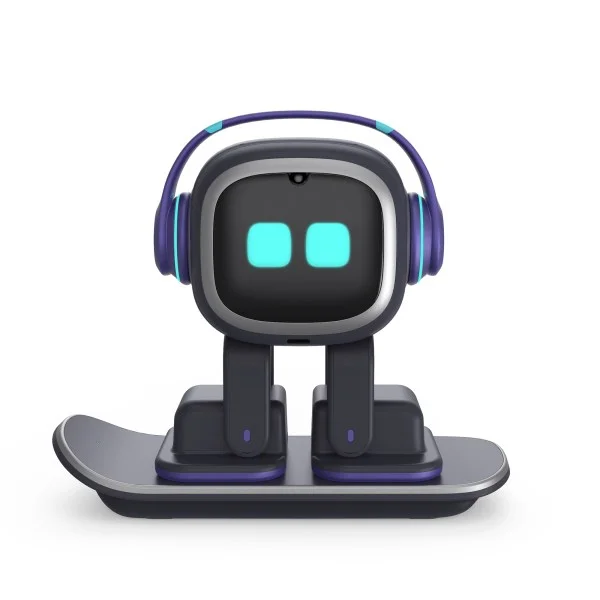
LivingAI presents EMO as an expressive desktop pet with movement, sound and touch interaction. Casio presents Moflin through touch, changing behavior and an evolving personality. Those are different physical experiences, even though both appear in robot-pet searches. The useful comparison concerns where the robot lives, how you interact with it and what a normal day looks like. This guide draws on their published descriptions; it does not award either a hands-on rating.
Terms such as personality and emotion describe the product's behavior and how it is presented. They do not establish that it has human feelings. You can enjoy a character's apparent preferences without needing to make that claim. Watch complete, ordinary interactions as well as promotional highlights, and consider whether its sound, movement and need for attention suit the place you intend to keep it.
Know what you are choosing to build
Petoi's Bittle X material describes a path from preset movements to custom skills using its apps, coding blocks, Python and C++. The attraction is the opportunity to understand and alter behavior. That opportunity also means assembly, calibration and version-specific instructions matter. Petoi's documentation hub now separates legacy models from newer Bittle X V2 documentation, a useful reminder that a product family name is not enough when following a tutorial.
Before ordering, open the first lesson for your exact kit. Check the supported computer, required software and steps between unboxing and the first movement. Look for instructions that explain how to return to a known working state. A friendly beginner project lets you change one thing, observe the result and recover when the change fails. A large library of advanced examples is less useful if that first path is missing.
Inspect the setup you will actually use
Connectivity requirements deserve a quick check against your home. LivingAI's original 2021 EMO manual specifies a 2.4 GHz Wi-Fi network and a mobile app. That is a specific setup condition, not proof that every feature needs a constant cloud connection. For any candidate, establish which features work without internet, which require an account and whether the phone is needed only for setup or during ordinary use.
EMO makes the charging choice concrete. Its base offer uses the Skateboard accessory, while GO HOME adds a station that LivingAI says EMO can return to for charging. Existing owners can buy Home Station separately with the required firmware update; that accessory purchase does not include a robot. Decide whether manually placing a companion on its charger fits your routine, then compare the exact package and delivered price.
Also compare the included charger, docking arrangement, supported surfaces and clear operating space. A roaming pet, a stationary companion and a small legged kit need different surroundings. Decide where cables and accessories will stay. Ask how the robot is powered off or silenced when you need to concentrate. These practical details often influence continued use more than an extra animation in the feature list.
Try a software path before buying hardware
A simulation can help you discover whether programming a character is enjoyable. Reachy Mini documents a MuJoCo simulation that supports application prototyping without a physical robot. It is a useful way to explore a development workflow, although an on-screen model cannot tell you how the finished hardware sounds, feels or behaves on your desk. Treat it as a trial of the activity rather than a substitute for a physical review.
Set yourself a modest challenge: run an existing example, change a movement or response, and explain what changed. If you enjoy that process, a programmable robot may offer more lasting value than a longer menu of preset tricks. If you find yourself wanting to close the laptop and simply interact, use that discovery to favor a finished companion with clear support and setup documentation.
Make a shortlist that reflects your purpose
Limit the first comparison to two or three candidates. Record the exact edition, current purchase status, full delivered price, charging equipment, app requirements and repair route. Separate promised future capabilities from released features. Check whether replacement batteries and other likely service parts can be obtained, and who handles a fault in your country. A lower sticker price can lose its appeal if a routine repair has no practical route.
Choose a finished companion when its documented daily interaction is the experience you want. Choose a kit when you want to learn by changing the system and can make time for its setup. There is room to move between the two later. The first purchase should make your first month enjoyable and achievable, with a clear next activity beyond replaying the launch video.